
Imagine you find a beautiful quartz crystal.
Maybe it formed naturally underground over thousands of years. Maybe someone grew it in a laboratory under carefully controlled conditions.
If both crystals are genuinely quartz, they have the same fundamental chemical composition: silicon dioxide.
But they might not look identical. One may contain mineral inclusions, microscopic defects, or impurities. The other might be exceptionally uniform.
Their chemical identity can be the same while some of their physical characteristics differ.
Now, what does any of this have to do with peptides?
Quite a lot, actually.
First, What Is a Peptide?
Think of amino acids as letters in an alphabet.
A peptide is a short chain of those letters arranged in a particular order.
For example, one peptide studied in the Khavinson research tradition is Epitalon, a tetrapeptide containing four amino acids (Khavinson et al., Molecules, 2020):
Alanine – Glutamate – Aspartate – Glycine
Or, in scientific shorthand: AEDG.

That sequence is like a four-letter word. Change the letters, their order, or certain aspects of their chemistry, and you may change the molecule.
But here's the interesting part.
Knowing the letters doesn't necessarily tell you everything about the finished product containing them.
Same Recipe. Different Kitchen.
Imagine giving two professional bakers the exact same recipe.
Same ingredients. Same quantities.
But one uses a different oven temperature, mixing method, or baking time.
The finished cakes might be noticeably different.
Peptide synthesis has a similar distinction between the intended molecular structure and the manufacturing process used to produce it.
Scientists can assemble amino acids using established chemical techniques, including solid-phase peptide synthesis (Merrifield, 1963).
During manufacturing, however, several things can happen.
A reaction may fail to attach an amino acid correctly. An unwanted chemical modification may occur. A small amount of a different molecular variant may form.
These are among the reasons manufacturers use purification procedures and analytical testing (D'Hondt et al., 2014).
Unlike baking, though, there's an important scientific limit to the analogy:
If two manufacturers produce exactly the same peptide molecules, with the same relevant chemical structure, those molecules do not acquire different biological identities merely because they came from different laboratories.
What may differ is the preparation surrounding those molecules, such as impurities, the salt form the peptide is supplied in, other ingredients, and how much peptide is actually present.
The Crystal Connection
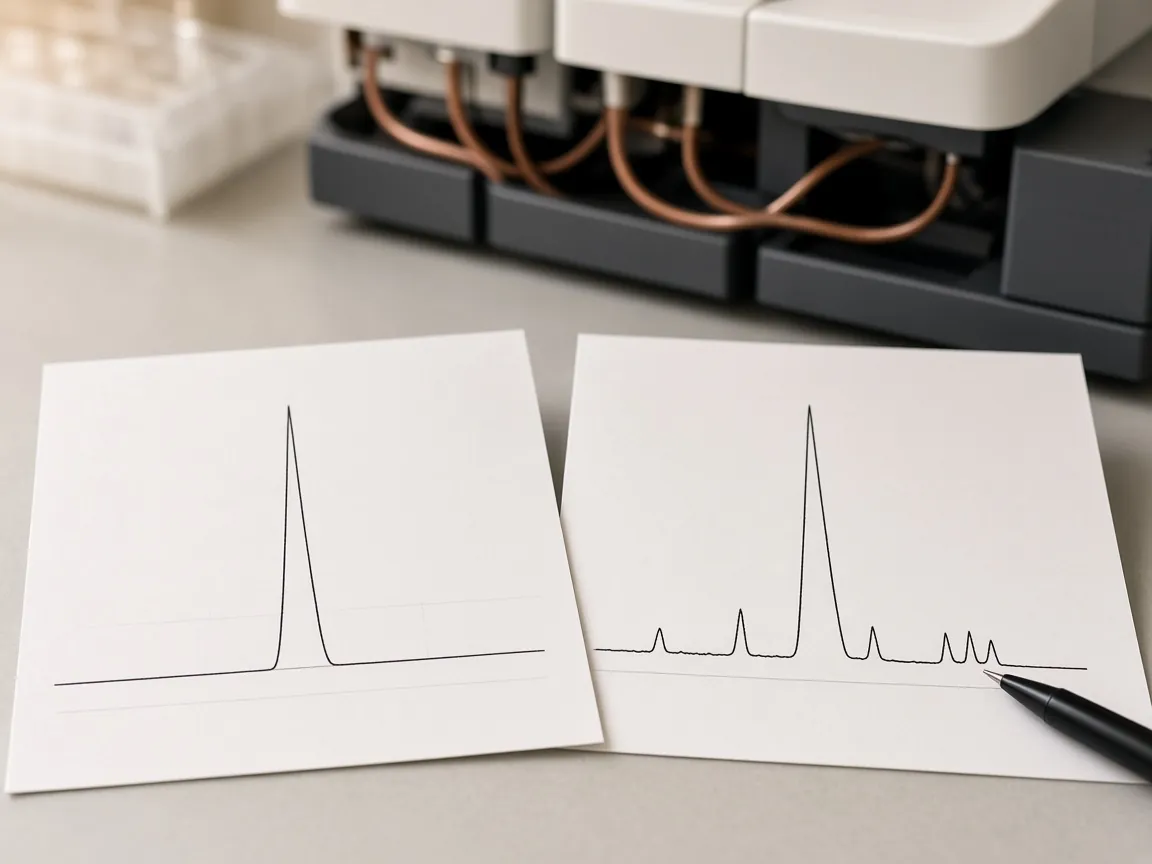
Let's return to our quartz.
The way a crystal grows can influence its defects, inclusions, and physical characteristics.
Similarly, the way a peptide product is manufactured can influence its purity, stability, and other properties.
There are several possibilities worth understanding.
1. The wrong molecular arrangement
Apart from glycine, which has no mirror-image form, the amino acids used to build proteins have a particular three-dimensional configuration called the L-form. Their mirror images are called D-forms.
These are mirror-image arrangements, rather like your left and right hands.
They may look similar on paper, but biological enzymes and receptors can distinguish between them.
If an unintended stereochemical variant forms during synthesis, the resulting molecule may behave differently.
2. Unwanted chemical passengers
Manufacturing can leave behind residual reagents, truncated peptide sequences, or other impurities.
The presence, amount, and biological significance of these impurities depend on the particular product.
3. Different formulations
A peptide in a dry powder, a capsule, or a solution is not necessarily exposed to the same conditions.
Other ingredients, moisture, acidity, and storage conditions can influence stability.
And for orally administered peptides, digestion and absorption introduce additional questions, so findings from injected or cell-based research cannot simply be assumed to apply to oral products.
4. Different mixtures altogether
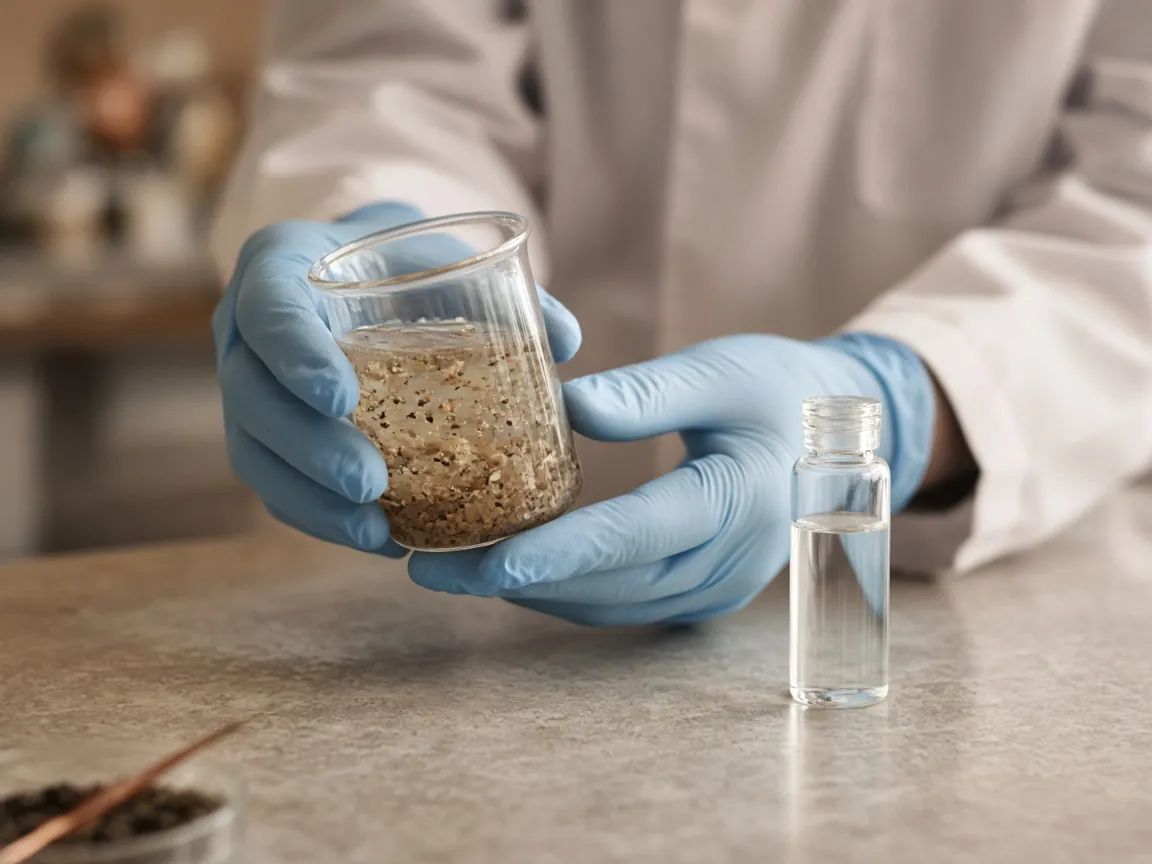
This becomes particularly important when discussing peptide complexes extracted from biological tissues.
A tissue extract can contain multiple molecular components.
Reproducing one identified peptide from that mixture does not necessarily reproduce the mixture itself.
Enter the Khavinson Peptides
Professor Vladimir Khavinson and his collaborators investigated peptide bioregulation through a research program originating in St. Petersburg, Russia.
Their work included both tissue-derived peptide preparations and short synthetic peptides (Khavinson, 2002).
That's a distinction worth remembering.
A defined synthetic peptide can, in principle, be reproduced by another laboratory with the appropriate technical expertise.
But a branded finished product may involve particular manufacturing specifications, formulations, quality-control methods, and sourcing arrangements.
Some inventions associated with peptide bioregulation have been patented. Patents can protect particular molecules, methods, formulations, or uses, depending on their claims.1
Other manufacturing knowledge may be proprietary.
However, the existence of a patent doesn't automatically prove that a particular product uses an exclusive synthesis process, or that separately manufactured versions behave differently.
To establish that, we'd need to examine the relevant patent claims and compare the actual preparations.
Which brings us to the central question.
Can You Copy the Molecule Without Copying the Product?
Often, yes.
But that doesn't automatically mean the copy is worse.
Suppose Laboratory A and Laboratory B both manufacture AEDG.
If both produce the same fully characterized molecule, their AEDG molecules are chemically identical.
Yet their finished products might still differ in purity, concentration, formulation, or stability.
Those differences could matter, depending on the preparation and how it is used.
Alternatively, both manufacturers might produce equally well-characterized, high-quality products.
Manufacturing differences create questions about equivalence. They don't automatically establish superiority.
That's an important distinction in science.
What About Patents and Proprietary Processes?
A patent is not simply a certificate declaring that someone invented the best version of a molecule.
It is a legal right attached to specific claims, generally granted in exchange for publicly disclosing an invention.
Depending on the patent, those claims might concern a chemical composition, manufacturing method, formulation, or particular application.
A trade secret is different: it involves commercially valuable information kept confidential.
So when someone describes a peptide product as patented or proprietary, the next question should be:
What, exactly, is protected?
The peptide itself? A way of producing it? A particular combination of ingredients? A method of use?
Without that information, the words alone tell us surprisingly little about whether another product is equivalent.2
Does This Mean Cheaper Peptides Are Fake?
No.
Price alone cannot establish chemical quality or authenticity.
A cheaper product may be legitimately manufactured, sold at a different margin, or distributed through another business model.
It may also be a separately synthesized peptide rather than an original branded formulation.
And sometimes, of course, a product's stated identity or origin may be misleading.
That's why we need to distinguish three questions:
- Chemical identity: Is this actually the molecule named on the label?
- Product quality: Does it meet appropriate specifications for composition, purity, and stability?
- Authenticity: Is it genuinely manufactured by the company whose product it claims to be?3
These questions are related, but they are not interchangeable (WHO, Substandard and falsified medical products).4
The Bigger Picture
Peptide science is fascinating partly because small molecular differences can sometimes have important biological consequences.
But that doesn't mean every difference in manufacturing produces a meaningful change in biological activity.
The evidence has to establish that connection.
When evaluating any peptide product, we should ask what molecule was studied, what formulation was used, how the material was characterized, and whether findings from one preparation can reasonably be applied to another.
This is especially important when interpreting research on peptide bioregulators, where synthetic peptides and tissue-derived complexes often appear side by side in the same broader scientific literature, and where many studies are cell, animal or injected-preparation research rather than trials of oral products.
So, can you reproduce a peptide sequence?
Often, yes.
Can you reproduce a particular finished product simply by knowing that sequence?
Not necessarily.
And can you conclude that one version works better because of where or how it was manufactured?
Not without evidence.
The sequence tells you what molecule you're trying to make. It doesn't tell you everything about the product you end up with.
And that is why the science doesn't end with the sequence.
Notes
- Patents are also territorial and time-limited, so a patent granted in one country, or one that has expired, may not cover products sold elsewhere today. ↩
- Patented or proprietary describes a legal status, not a measured difference in quality or effect. ↩
- Identity and purity can be checked by laboratory testing (for example, mass spectrometry and HPLC) reported on a certificate of analysis; authenticity depends on the supplier's documentation and chain of custody. ↩
- WHO defines these terms for medicines and other medical products. We borrow the distinction here; dietary supplements are a different regulatory category. ↩
Go Deeper · Curious? Follow the research.
For peptide synthesis and manufacturing
- Merrifield, R. B. (1963). Solid Phase Peptide Synthesis. I. The Synthesis of a Tetrapeptide. J. Am. Chem. Soc. 85(14), 2149–2154. DOI: 10.1021/ja00897a025. The foundational paper introducing solid-phase peptide synthesis.
- D'Hondt, M. et al. (2014). Related impurities in peptide medicines. J. Pharm. Biomed. Anal. 101, 2–30. doi: 10.1016/j.jpba.2014.06.012.
For the Khavinson research tradition
- Khavinson, V. Kh., & Anisimov, V. N. (2009). Peptide regulation of aging: 35-year research experience. Bull Exp Biol Med, 148(1), 94–98. PMID: 19902107. doi: 10.1007/s10517-009-0650-8.
- Khavinson, V. Kh. (2002). Peptides and ageing. Neuro Endocrinol Lett, 23 Suppl 3, 11–144. PMID: 12374906. (Covers both tissue-derived and synthetic peptides.)
- Khavinson, V. et al. (2020). AEDG Peptide (Epitalon) Stimulates Gene Expression and Protein Synthesis during Neurogenesis: Possible Epigenetic Mechanism. Molecules, 25(3), 609. doi: 10.3390/molecules25030609. A cell-culture study; the mechanism it proposes is a hypothesis, not established biology. These studies should be assessed individually rather than treated as proof of clinical benefit for all commercially available formulations.
For manufacturing quality and authenticity
- WHO, Substandard and falsified medical products (fact sheet). who.int. Explains the distinction between products that fail quality standards and those that deliberately misrepresent their identity, composition, or source. (Defined for medical products; used here as an analogy.)
- USP General Chapter <1503> Quality Attributes of Synthetic Peptide Drug Substances (USP–NF). doi.usp.org (a drug-substance standard, cited as a reference point for what peptide specifications cover).
- 21 CFR Part 111, Current Good Manufacturing Practice in Manufacturing, Packaging, Labeling, or Holding Operations for Dietary Supplements.
For how regulators evaluate peptide drugs
- U.S. FDA (December 2023). Clinical Pharmacology Considerations for Peptide Drug Products. Draft guidance for industry (not for implementation). Docket FDA-2023-D-3391. fda.gov. A draft guidance for peptide drugs, cited for how regulators think about peptides; it does not apply to supplements.
More studies, organised by tissue, are in the library.
Research discussed here does not establish the safety or effectiveness of any particular commercial peptide product. How we work: editorial standards.